


Hedera faces a key technical test as traders watch for a possible rebound, while its new testnet launch brings AI-powered access to blockchain operations. The integration lets developers direct tasks through AI assistants while retaining final wallet-based approval, connecting easier network access with user-controlled transaction authorization.
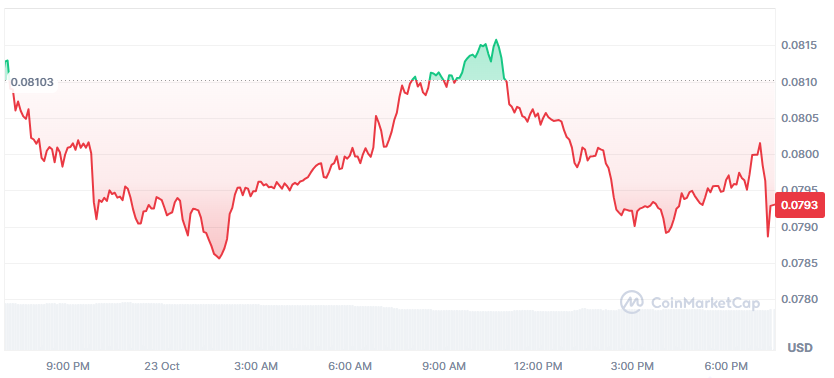
As of now, according to CoinMarketCap data, Hedera is trading at $0.07968, down 1.12% over the past 24 hours and 7.53% over the past week.
HBAR Tests $0.080 Support as Analyst Maps Potential Path to $0.20
Crypto analyst Giannis Andreou says HBAR is testing a key support zone between $0.080 and $0.084 after a daily pullback. The token needs to stabilize in this area and reclaim nearby resistance levels to strengthen the possibility of a broader recovery.
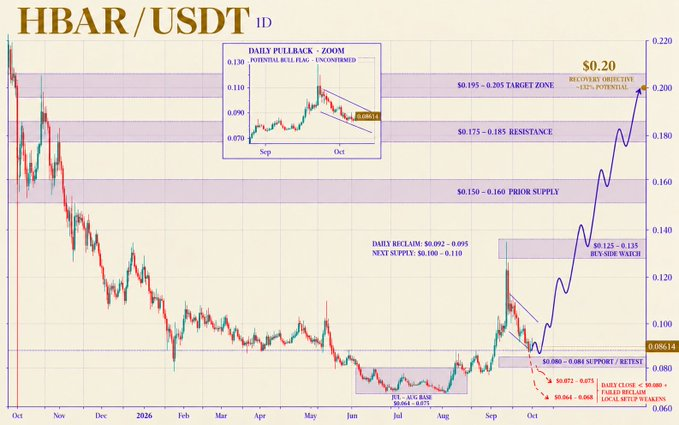
The first resistance level stands at $0.092–$0.095, with a heavy supply zone at $0.10–$0.11 acting as another obstacle to further upside. A break above these levels could lead to $0.125–$0.135, with even higher targets around $0.15–$0.16 and $0.175–$0.185.
A sustained move through these resistance zones could put $0.20 in focus. Measured from the chart’s reference price of $0.08614, this target represents an increase of approximately 132%. The bullish outlook would weaken if HBAR closes below $0.080 on the daily chart and fails to reclaim that level, potentially exposing the $0.072–$0.075 support zone.
Hedera Launches Network MCP on Testnet for AI-Powered Blockchain Access
The data from Hedera further shows that the network has launched its Network MCP on testnet, allowing AI tools such as Claude Code, Codex, Cursor, and ChatGPT to connect to the platform through a single endpoint.
Through the MCP integration, developers can instruct their AI agents to perform blockchain-related tasks, including sending HBAR, creating tokens, and retrieving network data. This setup could make blockchain operations more accessible by allowing users to issue commands through AI-powered tools.
Users must approve and sign transactions through their own wallets before the network can finalize them. This process keeps authorization under their control rather than finalizing transactions automatically. Since the service currently runs on testnet, developers can explore its capabilities before a potential mainnet deployment.