
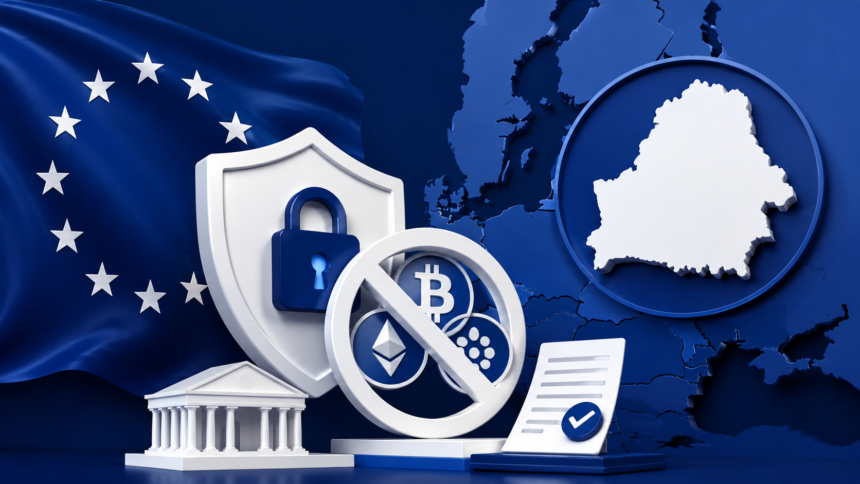
The European Union (EU) has widened its Belarus sanctions by prohibiting Belarusian nationals and residents from owning, controlling, or serving on the governing bodies of crypto-asset service providers approved under MiCA. The EU adopted Council Decision (CFSP) 2026/1847 on July 23, brought it into force on July 24, and will begin applying the crypto rule on August 25.
The update goes beyond earlier sanctions that covered only crypto wallet, account, and custody services. Once the new rule begins to apply, the ban will cover every crypto-asset service category listed under MiCA, including trading platforms, exchange services, order execution, transfer services, investment advice, and portfolio management.
Under the new framework, Belarusian nationals and residents will not be permitted to own or control EU firms that offer those services. They will also be barred from serving on the governing bodies of such firms, adding direct ownership and management restrictions to the sanctions list.
EU Expands Belarus Crypto Service Restrictions
An earlier Council Decision, CFSP 2026/512, adopted in April, had already restricted Belarusian involvement in firms offering crypto wallet, account, or custody services. It also prohibited EU residents from dealing with Belarusian crypto service providers. The latest amendment extends the same policy to every MiCA service line.
MiCA’s transition period ended at the start of July. Crypto firms still active in the EU now need full CASP authorization, or they must shut down. The Belarus rule comes on top of that licensing shift, leaving firms to face both market access rules and sanctions limits at the same time.
The timing matters because the ownership ban will come just weeks after the MiCA transition deadline. Any EU-based crypto company will need to check ownership, control, and board structure before August 25, since Belarusian nationals or residents may no longer hold those positions in the covered firms.
Russia Sanctions Tighten Further
The Belarus measure came alongside the EU’s 21st sanctions package against Russia. The package expanded transaction bans to 14 crypto-related platforms outside the bloc and added a path for the EU to block dealings with foreign crypto providers used to help Russia evade sanctions.
The same package also targeted 94 Russian banks and the Moscow Exchange. European officials have been increasing pressure on crypto channels they view as possible routes for sanctions evasion or other financial channels linked to Russia’s war against Ukraine.
A June 11 proposal had listed 11 crypto platforms, but the final package increased the total to 14. The latest move followed a May 26 action by the United Kingdom, which sanctioned Huobi Global S.A., the Panama-based company behind HTX, over claims tied to Russia-linked financial networks.